INFOTH Note 6: Kraft's Inequality, Shannon Code
6.1 Coding and Compression
Def: Code / Encoding
We define a coding/encoding map as follows:
\[ c:\mathcal X^n\to\{0,1\}^*-\empty \]We say this map is nonsingular iff it’s injective. (thesaurus)
The input is a sequence of source symbols (I call it a source word), and the output (image) is a codeword.
If the < means being a subset of,
- Instantaneous codes < Uniquely decodable codes < Nonsingular codes < All codes
- Nonsingular: injective (again)
- Uniquely decodable: Every sequence concatenated by codewords can only be decoded to only 1 source sequence.
- The “Kleene Closure” of the map is also injective.
- 整个由codeword接成的序列也只能被解码成唯一的source word序列。
- If \(A\to0,B\to1,C\to01\), we cannot tell the original seq. from 0101 though this coding is nonsingular.
We can process the coding like a path in a binary tree.
Def: Multi-symbol Compression
\[ c(x_1,\dots,x_k)=c(x_{1:k})=[c(x_1),c(x_2),\dots,c(x_k)] \]as a multi-symbol compression of a concatenated source words, equal to a concatenation of codewords.
Def: Code Extension
The extension of predefined \(c\) is
\[ c^*:\mathcal X^*-\empty\to\{0,1\}^*-\empty \]- variable finite length
- \(\mathcal X=\{A,B\}\) then \(\mathcal X^*=\{\empty,A,B,AA,AB,BB,AAA,AAB,ABA,\dots\}\)
Def: Uniquely Decodable
\(c\) is called uniquely decodable if its extension is nonsingular.
- UD -> Lossless Compression
Def: Prefix-free = Instantaneous
\(c\) is called prefix-free or instantaneous if \(\forall x\ne x'\), \(c(x)\) is not a prefix of \(c(x')\).
- UD but not PF codes:
- \(A\to 1,B\to 10\)
- \(1\to0,2\to01,3\to11\)
Theorem: Kraft’s Inequality
For any prefix free code over \(\mathcal X\) i.e. \(c:\mathcal X\to\{0,1\}^*-\empty\),
\[ \sum_{x\in\mathcal X}2^{-l(c(x))}\le 1 \]where \(l(c(x))\) is the length of \(c(x)\).
- The 2-exponentials of negative lengths of codewords sum up less than 1.
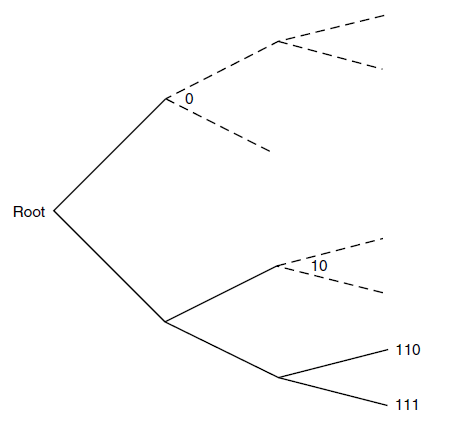
We can construct a binary tree for every prefix-free code. Every leaf represents a codeword, we goes left (down) to add 1 and right (up) to add 0, and the codeword is the path from the root to the leaf itself.
In the picture, we have 0,10,110,111 as codewords for a prefix-free code.
Proof. For the case with 2 leaves with length \(h\) and value \(2^{-h}\), they can be merged into their parents with a summed \(2^{-h+1}\), or there are only 1 leaf and we merge \(2^{-h}\) as it is. We find the case of max sum is when we reach a full binary tree (every leaf has 0 or 2 children), and the sum is 1. Otherwise, it’s smaller than 1.
6.2 Minimum Expected Length of the Code
For the space \(\mathcal X\), every source word \(x\) has a probability of appearance. So we want to minimize the expected length of the code over all prefix-free codes.
\[ \min_{c\in \text{PF}(\mathcal X)} \sum_{x\in\mathcal X}p(x)l(c(x)) \]Converse Kraft’s Inequality
The original Kraft’s Ineq.: For a prefix-free code \(c\), \(\sum_x 2^{-l(c(x))}\le 1\)
Converse:
Given \(\mathcal X\) a finite set, given \((l(x),x\in\mathcal X)\) and \(l(x)\ge 1\) (integers), \(\forall x\) s.t.
\[ \sum_x 2^{-l(x)}\le 1, \]then \(\exist c:\mathcal X\to \{0,1\}^*-\empty\) s.t. \(l(c(x))=l(x),\forall x\) and \(c\) is a prefix-free code.
给定一组 \(l(x)\) 函数的值,也就是一个正整数向量,如果满足Kraft的不等式则存在PF Code对应这个长度组。
Optimization
Converse Kraft -> We want to find such a collection of \(l(x)\) to minimize the expected length (given a fixed \(p\) distribution)
\[ \min_{(l(x),x\in\mathcal X,l\in\Z^+)}\sum_x p(x)l(x)\qquad\text{s.t.}\sum_x2^{-l(x)}\le 1 \]Since \(\sum_{x}2^{-l(x)}\le 1\) we have already satisfied \(l(x)\ge 0\), otherwise one term where \(l(x)<0\) will make the sum greater than 1.
This problem is a difficult integer programming, so we do relaxation to real values.
Relaxation of Integer Programming
We relax the lengths to real values
\[ \min_{(l(x)\in\R,x\in\mathcal X)}\sum_xp(x)l(x)\qquad\text{s.t.}\sum_x2^{-l(x)}\le 1 \]KKT Conditions:
-
Lagrange Multiplier, Stationarity
\[ L(x,\lambda)=\sum_xp(x)l(x)+\lambda(\sum_{x\in\mathcal X}2^{-l(x)}-1)\\ \nabla_{(l(x),x\in\mathcal X)} L=0 \] -
Primal Feasibility
\[ \sum_x 2^{-l(x)}\le 1 \] -
Dual Feasibility
\[ \lambda\ge 0 \] -
Complementary Slackness
\[ \lambda(\sum_x 2^{-l(x)}-1)=0 \]
(vector perspective)
\[ L=\mathbf p\cdot \mathbf l+\lambda(2^{-\mathbf l}-1)\implies \nabla_{\mathbf l}L=\mathbf p+\lambda\cdot \ln2\cdot 2^{-\mathbf l}=0\implies \mathbf l=K\log_2 \mathbf p \](one of \(l(x)\) perspective)
For any \(x\),
\[ \begin{aligned} \nabla_{l(x)}L=0&\implies \nabla_{l(x)}(p(x)l(x)+\lambda\cdot 2^{-l(x)})=0 \\&\implies p(x)+\underbrace{\lambda \ln 2}_{-\frac1c}\cdot 2^{-l(x)}=0 \\&\implies 2^{-l(x)}=cp(x) \\&\implies l(x)=-\log cp(x)=-\log c-\log p(x). \end{aligned} \]Since \(\sum_{x} 2^{-l(x)}=1\),
\[ \sum_x (2^{\log c+\log p(x)})=1\implies c\sum_x p(x)=1\implies c=1. \]Hence the optimal solution \(l^*(x)\) is
\[ l^*(x)=-\log p(x) \]and we find that the expected length is the entropy of \(p\)
\[ \text{Objective}=E_p[l(X)]=\sum_x p(x)l(x)=H(p). \]Coming back to IP
In integer programming i.e. the original problem, we can then find the solution:
\[ \hat l^*(x)=\lceil\log \frac1{p(x)}\rceil,\forall x\in\mathcal X \]where the ceiling is applied to satisfy the primal feasibility, and we call the code following this length collection a Shannon code.
Note that if we change the log base from 2 to \(e\) or any other \(D\), the solution still holds with \(\log\equiv \log_D\).
6.3 Shannon Code
Def: Shannon Code \(c_S\)
Define on the finite set \(\mathcal X\),
\[ l_S(x):=\lceil\log \frac1{p(x)}\rceil,\forall x\in\mathcal X \]satisfying \(\sum_x 2^{-l_S(x)}\le 1\) (converse Kraft’s inequality), therefore, there exists a prefix-free code
\[ \exist c_S:\mathcal X\to\{0,1\}^*-\empty \]with \(l(c_S(x))=l_S(x),\forall x\).
We call such a code a Shannon code, where
\[ H(X)\le E[l(c_S(X))]= \sum_x p(x)l(c_S(x))=\sum_x p(x)\lceil \log\frac{1}{p(x)}\rceil\le H(X)+1 \]minimizes the expected length.
If the entropy is small…
If \(H(X)\) is small, say, smaller than 1, the code for one symbol may be not so great.
However, we can do this over blocks of symbols (concatenation)
Block Shannon Code
For a block (multiple symbols) with \(k\) symbols, i.i.d. the distribution \(p\),
\[ c_S^k:\mathcal X^k\to\{0,1\}^*-\empty,\qquad\text{s.t.}\quad l(c_S(\bold x^k))=\sum_{i=1}^k l(c_S(x_i)) \]Then
\[ E_p[l(c_S(\bold X^k))]=\sum_{\bold x^k}p(\bold x^k)l(c_S(\bold x^k))\le H(\bold X^k)+1=kH(X)+1. \]So the average expected length for one symbol is
\[ \overline{E_p[l(c_S(X))]}=\frac1k\sum_{\bold x^k}p(\bold x^k)l(c_S(\bold x^k))\le H(X)+\frac1k, \]thereby we can use a long block to lower the length bound closer to the entropy.
Compression Rate
Though it’s late, we define the expected length as the compression rate that is
\[ CR(c)=E[{\text{\# of bits}\over\text{\# of symbols}}]=E_p[l(c(X))] \]- UD but not Prefix-free is not better.
- Theorem: No UD codes have a better (smaller) compression rate than PF ones.
Kraft-McMillian Inequality
UD codes can also follow Kraft’s Inequality though. This conclusion expands that of PF to UDs.
\[ \sum_{x\in\mathcal X}2^{-l(c(x))}\le 1 \]Proof.
Consider a \(k\)-length symbol block. We consider the length of its codeword block.
Let \(l_{\max}=\max_x l(c(x))\) then for any \(k\)-length block, since \(c(\bold x^k)=c(x_1)+c(x_2)+\dots+c(x_k)\),
\[ \sum_{\bold x^k}2^{-l(c(\bold x^k))}=\sum_{x_1}\sum_{x_2}\cdots\sum_{x_k}2^{-l(c(x_1))}2^{-l(c(x_2))}\cdots2^{-l(c(x_k))} =\left(\sum_x 2^{-l(c(x))}\right)^{k} \]and we have
\[ \sum_{\bold x^k}2^{-l(c(\bold x^k))}=\sum_{l=1}^{k\cdot l_{\max}}2^{-l}N(l) \]where \(N(l)\) is the count of the codewords with length \(l\). 某个长度的出现次数
But since the codeword of length \(l\) is in \(\{0,1\}^l\) with size \(2^l\), \(N(l)\le 2^l\), hence
\[ \sum_{\bold x^k}2^{-l(c(\bold x^k))}=\sum_{l=1}^{k\cdot l_{\max}}2^{-l}N(l)\le \sum_{l=1}^{k\cdot l_{\max}}1 =kl_{\max}. \]Hence
\[ \sum_x 2^{-l(c(x))} \le (k l_{\max})^{1/k},\forall k\in \Z^+. \]When \(k\to \infty\), the RHS approaches to 1, so
\[ \sum_x 2^{-l(c(x))}\le \inf_k(kl_{\max})^{1/k}=1. \]